


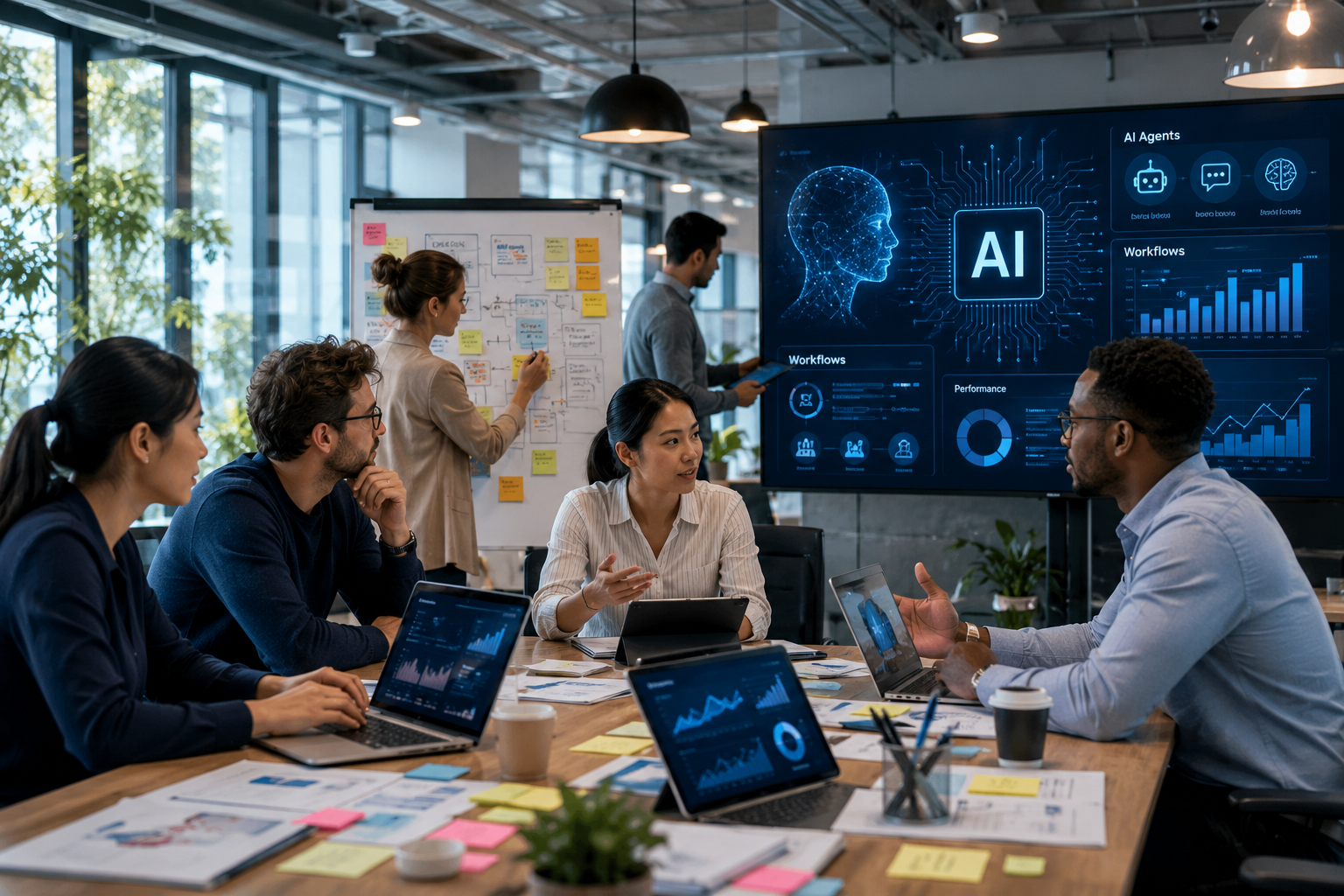
Artificial intelligence is changing the business world at a remarkable pace. Companies across industries are investing heavily in AI tools, experimenting with automation, and searching for new ways to improve productivity. Yet despite the excitement, many organizations are discovering that simply adopting AI is not enough.
The real challenge is not the technology itself. The challenge is redesigning the way people work.
This idea sits at the center of a growing conversation about AI Business Transformation, and few companies are exploring it more deeply than WPP, one of Europe’s largest advertising groups. The company has even created a dedicated leadership position focused on understanding how humans and AI can work together effectively.
Leading that effort is Dr. Laura Weis, WPP’s head of human-AI strategy and transformation. Her message is simple but powerful: organizations that only layer AI onto existing processes will struggle to gain meaningful value. Businesses that rethink work itself will be the ones that succeed.
Why Businesses Are Struggling to Unlock AI’s Full Potential: AI Business Transformation
Many organizations approach AI with a familiar goal in mind: efficiency.
Executives often focus on reducing costs, accelerating workflows, and completing tasks faster. While these benefits are valuable, they may not be enough to create a lasting competitive advantage.
According to Weis, businesses frequently separate their AI strategy from their workforce strategy. One team manages technology, while another focuses on talent and people development.
This disconnect creates problems.
When AI implementation happens independently of workforce planning, companies miss opportunities to redesign how work gets done. Instead of transforming operations, they simply automate existing processes.
As a result, many businesses achieve small productivity gains but fail to create meaningful change.
The Rise of Human-AI Collaboration: AI Business Transformation
One of the biggest shifts happening in modern workplaces is the emergence of what Weis describes as a blended workforce.
This workforce includes both human employees and digital AI agents.
Traditionally, organizations have designed structures around people. Now, leaders must think about how humans and AI systems interact, share responsibilities, and create value together.
This requires a new way of thinking.
Rather than asking whether AI should replace workers, businesses should focus on how technology can support people in achieving better outcomes.
The goal is not competition between humans and machines. The goal is collaboration.
Companies that successfully integrate both may discover entirely new ways of operating.
Why Efficiency Alone Won’t Create a Competitive Advantage: AI Business Transformation
One of Weis’s strongest arguments challenges a common assumption about AI.
She believes businesses are spending too much time talking about efficiency.
Faster processes and lower costs can certainly improve performance. However, if every competitor uses AI to achieve the same efficiencies, those gains quickly become standard rather than unique.
Real differentiation comes from innovation.
Businesses should use AI not only to speed up work but also to rethink what work can become.
This means questioning long-standing processes and exploring entirely new opportunities.
Instead of asking:
- How can we do this faster?
Organizations should ask:
- How can we do this differently?
- What new value can we create?
- Which opportunities were previously impossible?
These questions often lead to more transformative outcomes than efficiency improvements alone.
AI Creates More Than Speed: AI Business Transformation
Many people view AI primarily as a tool for saving time.
While that is certainly true, Weis believes the larger opportunity lies elsewhere.
She argues that AI creates space.
When repetitive tasks are automated, employees gain more time to think, collaborate, experiment, and innovate.
Unfortunately, many organizations immediately fill that newly available time with additional work.
This can limit the technology’s potential.
Instead, businesses should intentionally protect some of that space.
Employees can use it to:
- Explore new ideas
- Connect different areas of expertise
- Develop creative solutions
- Strengthen relationships
- Identify new business opportunities
According to Weis, AI may be more valuable as a tool for expanding work than simply compressing it.
Redesigning Roles Around Human Strengths: AI Business Transformation
The rapid growth of AI has created concerns about job security across many industries.
Some organizations have responded by reducing headcount as automation increases.
Weis recommends a different approach.
Rather than eliminating roles, businesses should redesign them around uniquely human capabilities.
While AI excels at processing information and handling repetitive tasks, it still struggles with qualities such as:
- Judgment
- Emotional intelligence
- Discernment
- Leadership
- Complex decision-making
These skills remain critical in modern organizations.
By allowing AI to manage routine work, companies can free employees to focus on areas where human strengths matter most.
This shift can create more meaningful and valuable work rather than simply reducing workloads.
Rethinking What High Performance Means: AI Business Transformation
Another challenge facing organizations is the definition of high performance.
In many workplaces, employees are rewarded for completing large amounts of work quickly.
Weis believes this mindset needs to change.
She warns against what she describes as “glorified busyness.”
Working faster does not automatically create greater value.
The most effective employees are often those who:
- Connect people and ideas
- Solve complex problems
- Create clarity
- Drive innovation
- Build alignment across teams
These capabilities become even more important as AI handles routine activities.
Future high performers may be judged less by how much they produce and more by how effectively they think.
Why Team Health Matters Before AI Adoption: AI Business Transformation
Technology cannot fix broken workplace cultures.
In fact, Weis argues that AI often amplifies existing conditions.
Healthy teams with strong communication, clear decision-making structures, and psychological safety may become even more productive when AI is introduced.
However, struggling teams can experience the opposite effect.
If employees already face confusion, stress, or poor collaboration, AI may simply create additional complexity.
That is why organizations should evaluate team health before expanding AI programs.
Leaders should ask:
- Do employees feel comfortable sharing ideas?
- Is critical thinking encouraged?
- Are responsibilities clearly defined?
- Can teams adapt when circumstances change?
Without strong foundations, even advanced AI systems may fail to deliver meaningful results.
Knowing What Not to Automate: AI Business Transformation
As AI capabilities continue expanding, businesses face an important question:
Just because something can be automated, should it be?
Weis believes organizations must be extremely careful when making these decisions.
Many creative and intellectually rewarding tasks contribute to employee engagement and professional identity.
Examples include:
- Brainstorming ideas
- Writing creative briefs
- Developing concepts
- Solving complex challenges
- Designing new solutions
If companies automate too many of these activities, employees may lose a sense of ownership and purpose.
Successful AI Business Transformation requires balance.
Automation should remove frustration, not eliminate the aspects of work that people find meaningful.
The Future Belongs to Organizations That Rethink Work: AI Business Transformation
The most important lesson from WPP’s approach is that AI itself is not the transformation.
Technology provides new capabilities, but leadership determines how those capabilities are used.
Companies that simply add AI to existing processes may see modest gains.
Organizations willing to rethink work from the ground up have the potential to achieve something far more significant.
They can create workplaces where humans and AI complement one another, innovation becomes easier, and employees spend more time focusing on activities that generate genuine value.
Final Thoughts: AI Business Transformation
AI Business Transformation is not about adopting technology faster than competitors. It is about understanding how technology changes the nature of work itself.
WPP’s experience highlights an important reality facing organizations around the world. AI delivers its greatest value when businesses redesign roles, rethink performance, strengthen teams, and intentionally create space for innovation.
As AI adoption accelerates, companies that focus only on efficiency may struggle to stand out. Those that use AI as a catalyst for deeper organizational change may unlock entirely new opportunities for growth and success.
The future of business will not be shaped by AI alone. It will be shaped by leaders who understand how to combine human strengths and artificial intelligence in ways that create lasting value.
Read Other Interesting news here: Thyssenkrupp Restructuring
